
📦
Distributor Network Visibility
Monitoring distributor stock, order status, sales activity, and channel performance across multiple territories becomes difficult without centralized visibility.
Manage distributors, dealers, sales teams, inventory, schemes, CRM activities, warehouses, order fulfillment, and business operations through a centralized ERP platform built for fast-moving consumer goods businesses.
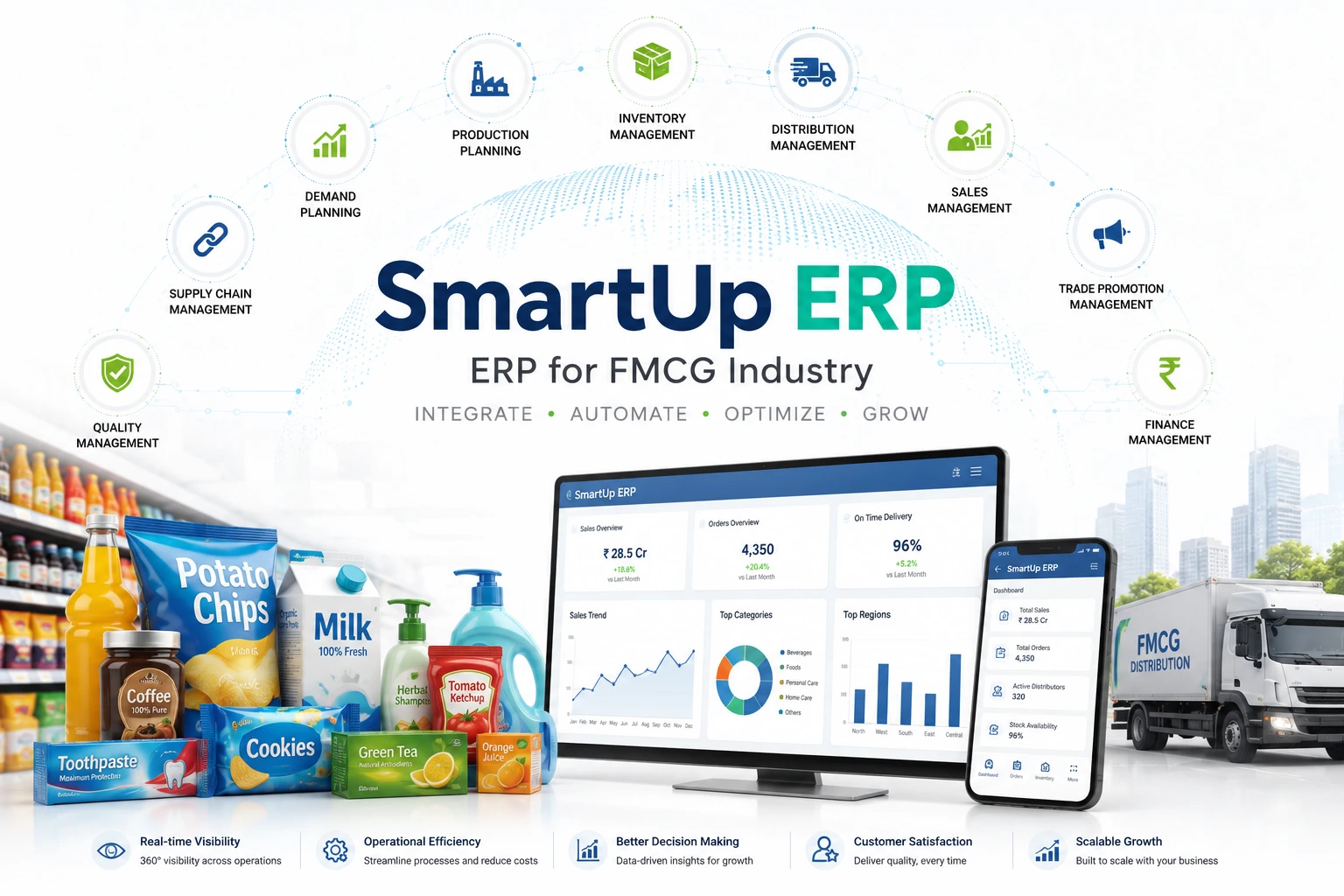
FMCG businesses operate across distributors, dealers, warehouses, field sales teams, and multiple customer touchpoints. As operations grow, maintaining visibility, inventory accuracy, sales performance, and channel coordination becomes increasingly complex.
Monitoring distributor stock, order status, sales activity, and channel performance across multiple territories becomes difficult without centralized visibility.
Excess inventory in one location and shortages in another can impact order fulfillment, customer satisfaction, and working capital.
Tracking executive performance, customer visits, follow-ups, quotations, and order conversion activities often becomes fragmented.
Managing dealer schemes, discounts, promotional campaigns, and incentive programs manually increases operational complexity.
Enquiries, leads, quotations, and customer interactions are often scattered across teams, resulting in missed opportunities.
Delayed reporting across sales, inventory, finance, and distribution makes it difficult to take timely business decisions.
FMCG businesses rely on distributors, dealers, channel partners, and field sales teams to reach markets efficiently.
As distribution networks expand, maintaining visibility across orders, inventory, outstanding payments, sales performance, and customer servicing becomes increasingly difficult through disconnected systems and manual coordination.
A centralized ERP platform helps connect distributors, sales teams, warehouses, customer interactions, and business reporting into a single operational ecosystem.
Monitor distributor sales, stock positions, order activity, collections, and overall channel performance from a centralized platform.
Improve dealer engagement through structured order processing, scheme visibility, account tracking, and communication workflows.
Track orders from booking through dispatch, invoicing, delivery confirmation, and customer fulfillment processes.
Connect warehouses, branches, distributors, and sales operations through a unified operational framework.
FMCG businesses require visibility across distribution, sales execution, customer relationships, inventory, schemes, and business performance. A centralized ERP platform helps connect these operational areas into one integrated ecosystem.
Track field executives, customer visits, follow-ups, sales activities, targets, and order conversion performance from a centralized platform.
Manage enquiries, leads, quotations, customer follow-ups, opportunity tracking, and sales pipeline visibility through structured workflows.
Monitor distributor performance, dealer orders, outstanding balances, collections, and channel partner activities across regions.
Control dealer schemes, trade promotions, discount structures, incentive programs, and promotional campaign execution.
Maintain real-time visibility into stock levels, warehouse inventory, item movement, replenishment requirements, and fulfillment readiness.
Access sales trends, demand forecasts, executive performance, profitability analysis, and operational dashboards for informed decisions.
A structured ERP platform helps FMCG businesses improve distribution visibility, sales execution, inventory control, customer engagement, and decision-making across the organization.
Monitor enquiries, quotations, orders, executive activities, distributor performance, and sales trends through centralized reporting.
Improve coordination with distributors, dealers, and channel partners while maintaining visibility into orders and collections.
Manage leads, follow-ups, quotations, customer interactions, and opportunities through structured CRM workflows.
Maintain inventory accuracy across warehouses, distributors, and operational locations while reducing stock shortages and excess inventory.
Manage dealer schemes, discounts, promotional activities, and performance-linked incentive programs more effectively.
Access real-time dashboards, MIS reports, profitability analysis, forecasting data, and operational insights from one platform.
FMCG organizations operate through different product categories, distribution channels, sales structures, and market strategies. ERP systems must support inventory visibility, distributor networks, sales operations, customer engagement, and business control across varied FMCG environments.
Manage inventory, distribution, order fulfillment, customer demand, and sales performance across fast-moving food and beverage product lines.
Improve visibility into sales operations, distributor activity, customer engagement, and inventory movement across markets.
Coordinate warehouses, distributors, sales teams, schemes, and customer orders through one centralized platform.
Strengthen channel operations through distributor management, dealer engagement, order tracking, and business reporting.
Connect branches, warehouses, sales teams, distributors, and finance operations through a unified ERP ecosystem.
Scale operations confidently with better control over inventory, sales execution, channel performance, and customer service.
FMCG businesses must coordinate distributors, sales teams, customer relationships, inventory, schemes, warehouses, and financial operations simultaneously. Compare how an integrated FMCG ERP platform improves visibility and control compared to disconnected systems and manual processes.
Common questions about ERP software for FMCG manufacturers, distributors, dealers, and consumer goods businesses.
Discover how SmartUp ERP helps FMCG businesses manage distributors, dealers, sales teams, customer relationships, inventory, warehouses, schemes, collections, and business operations through a centralized and scalable ERP ecosystem.
Improve channel visibility, order management, collections, and partner performance tracking.
Monitor field activities, lead follow-ups, quotations, and executive performance.
Maintain accurate stock visibility across warehouses, branches, and distribution networks.
Connect customer engagement, sales operations, forecasting, and management reporting.