
📞
Scattered Customer Communication
Customer enquiries, service requests, quotations, and follow-ups often remain spread across emails, spreadsheets, and individual team members.
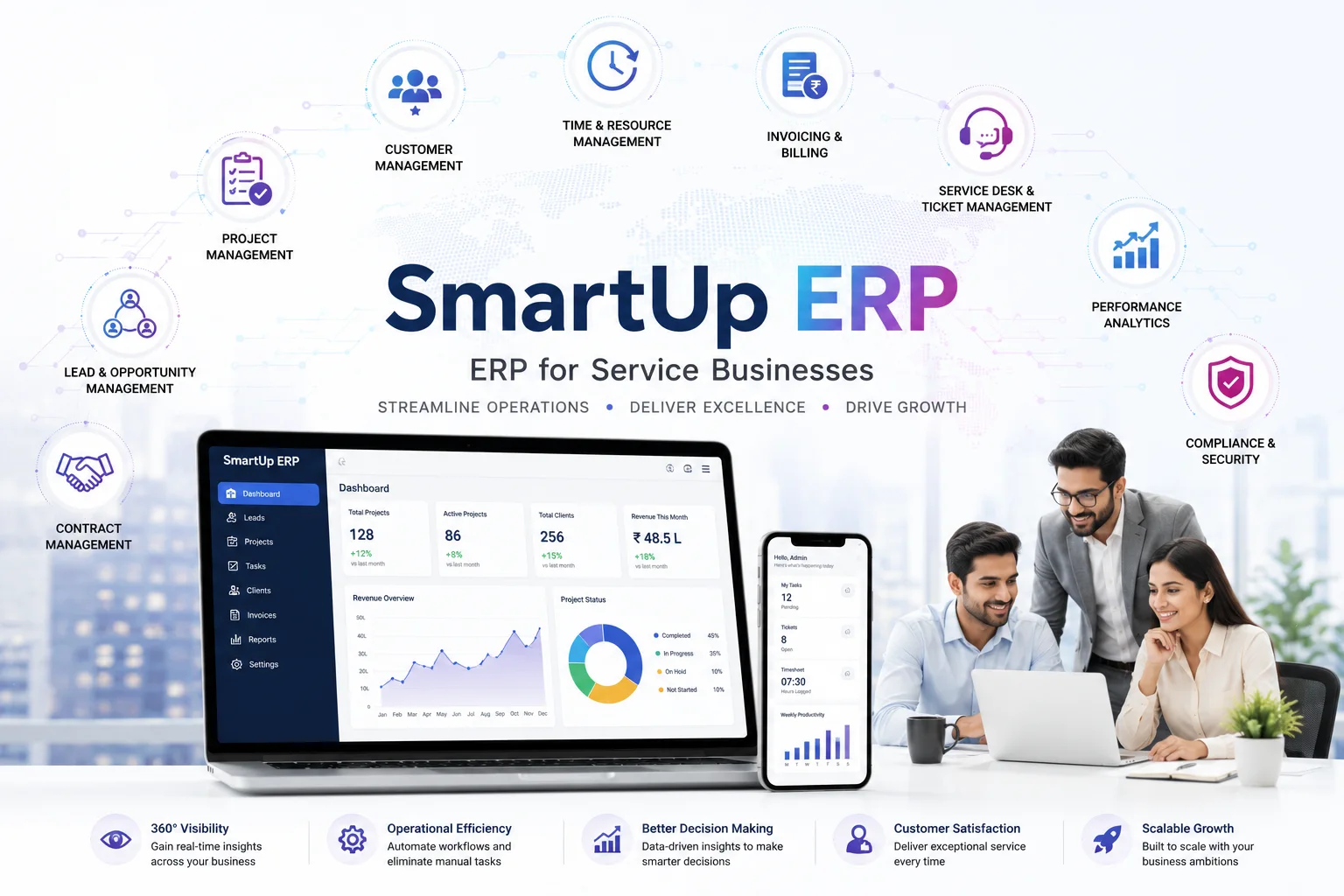
Manage customer enquiries, service contracts, field operations, engineer visits, ticket resolution, billing, finance, and business performance through a centralized ERP platform built for service-oriented organizations.
Service organizations depend on customer relationships, response times, contract commitments, field execution, and efficient billing processes. As service volumes grow, managing enquiries, support requests, engineer visits, customer communication, and financial control becomes increasingly complex.
Customer enquiries, service requests, quotations, and follow-ups often remain spread across emails, spreadsheets, and individual team members.
Monitoring service calls, ticket status, engineer assignments, and issue resolution becomes difficult without centralized visibility.
Service agreements, renewals, obligations, and customer commitments can become difficult to manage as the client base expands.
Planning engineer visits, tracking field activities, and monitoring service execution often requires significant manual coordination.
Missed billable activities, delayed invoicing, and disconnected service records can impact profitability and cash flow.
Without integrated reporting, management teams struggle to track service performance, customer satisfaction, revenue, and business growth.
Service businesses succeed when customer requests, field operations, billing activities, and financial records remain connected throughout the service lifecycle.
As service volumes increase, organizations often struggle with disconnected communication, delayed follow-ups, manual scheduling, and fragmented reporting. A centralized ERP platform helps unify customer interactions, service execution, invoicing, and operational visibility.
By connecting CRM, service contracts, ticket management, engineer visits, billing, and finance, businesses can improve response times, customer satisfaction, and operational efficiency.
Capture enquiries, manage leads, track quotations, and maintain customer communication from a centralized CRM environment.
Manage service contracts, customer commitments, renewals, and contractual obligations with better visibility.
Monitor support requests, service calls, escalation status, and resolution activities through structured workflows.
Schedule field visits, assign resources, monitor service execution, and improve operational coordination.
Service businesses require visibility across customer relationships, service delivery, field operations, contracts, billing, and financial performance. A centralized ERP platform helps connect these functions into a structured and scalable operating environment.
Capture enquiries, manage leads, track quotations, monitor follow-ups, and improve conversion visibility throughout the customer acquisition process.
Maintain customer agreements, service obligations, renewal schedules, contract terms, and service commitments from a centralized system.
Track support requests, service calls, escalation status, resolution timelines, and customer communication activities.
Plan engineer visits, allocate resources, monitor field activities, and improve service execution efficiency.
Connect service delivery with invoicing, collections, receivables, and financial processes to improve revenue visibility.
Access operational dashboards, profitability reports, service performance metrics, customer analytics, and business insights.
Beyond managing service requests and billing activities, ERP helps service organizations improve customer experience, operational efficiency, resource utilization, and financial control while creating a scalable foundation for long-term growth.
Centralized ticket management, service requests, and engineer scheduling help teams respond faster and improve customer satisfaction.
Structured follow-ups, service history, contract visibility, and proactive support help build long-term customer relationships.
Connect service execution with invoicing, reducing missed billable activities, delays, and revenue leakage.
Optimize engineer schedules, field visits, workload allocation, and service delivery efficiency.
Track revenues, expenses, receivables, profitability, and operational performance from one platform.
Standardized processes, centralized information, and business reporting help support expansion across teams, locations, and customer segments.
Service businesses operate with different customer expectations, service delivery models, contract structures, and field operations. ERP systems help bring consistency, visibility, and operational control across service-focused organizations.
Manage annual maintenance contracts, renewal schedules, service commitments, customer communication, and billing activities from a centralized platform.
Coordinate service requests, engineer visits, maintenance activities, customer history, and operational reporting.
Improve visibility into contracts, field execution, resource allocation, service billing, and financial performance.
Track customer enquiries, installation schedules, service calls, follow-ups, and completion status efficiently.
Manage distributed service teams, engineer assignments, visit planning, ticket resolution, and customer support operations.
Maintain control over customer agreements, service obligations, billing cycles, collections, and business reporting.
Practical questions business owners and service managers commonly ask when evaluating ERP software for service operations.
Spreadsheets may work in the early stages of a business, but as customer volumes, service requests, contracts, and billing activities increase, organizations often require a more structured system to maintain visibility and operational control.
Production planning, inventory control, costing, batch tracking, quality management, and operational visibility.

Manage procurement, inventory, warehouses, order fulfillment, dispatches, logistics, and multi-location distribution operations.

Formulation management, batch traceability, quality control, compliance records, costing, and production visibility.

Manage distributors, sales teams, inventory movement, schemes, demand forecasting, and retail distribution.

SmartUp ERP helps service businesses bring customer enquiries, service contracts, support requests, field operations, billing, finance, and reporting into one centralized platform. Gain better visibility, faster response times, stronger customer relationships, and greater operational efficiency as your business grows.
Connect enquiries, service history, contracts, tickets, and customer interactions through a unified system.
Improve visibility into support requests, engineer assignments, service execution, and operational performance.
Link service activities with invoicing, receivables, expenses, and financial reporting for stronger business control.
Support growing teams, expanding customer bases, multiple service locations, and increasing service volumes.